viernes, 8 de julio de 2022

Yoga, a unique tool to enhance our life

 It is interesting how we get used to using extremely sophisticated tools, being content to know what they produce and how they are used.

Totally ignoring their configuration or content, computers, GPS, and other multiple devices that make modern life easier for us, are of daily use even in the lives of the smallest.

In all these cases (electronic devices) their design has a specific and practical purpose and leads to its execution with maximum efficiency.

Extrapolating this pragmatism to any daily use, we include various disciplines in our entertainment assuming a similar operation. But it turns out that in some cases the "black boxes" we use have not been made for such an obvious purpose, nor is their design unidirectional. Such is the case of Yoga.

In the vast majority of beginners, the practice of Yoga is undertaken being an absolute victim of our inertia, projecting it just as the body casts its shadow, in the way we move, breathe and relate to the exercise.

Almost without exception, the beginner hopes to gain more strength, balance, flexibility, or whatever else he or she hopes to find in practice.

It establishes a relationship of beginning and goal with the exercise, linear, that measures in time, effort and results. It is continually evaluated against these parameters.

The faster you understand that developing any skill to the extreme is unnecessary in Yoga, the faster your development in this discipline will be.

The uniqueness of this practice lies in the fact that its realization does not depend only on the exercise itself, but rather on the relationship that we establish with it.

The exercise, which in most cases is the goal, here is just the means, the pretext... The real goal is to study our behavior in it. The most interesting moment that a Yoga teacher can experience in teaching is the moment when her student finally understands this enormous principle.

It is from then on that he stops pursuing Yoga and begins to live it. He stops strengthening his strong parts and begins to observe their contrasts. He stops caring about quantity, and starts caring about quality.

As I said at the beginning, being a victim of our inertia, we enter Yoga as if it were another field in which we must play our cards and become stronger, and win something. And the mere fact of understanding that such behavior is useless disarms us.

There is no competition, there is no goal (at least quantitatively measurable) and it is in fact curbing our inertia and learning new behaviors of our body, our brain, our emotions, our mind... what will bring enjoyment and the realization of that much persecuted relaxation, well-being and other golden dreams.

There is no “learn yoga in thirty days” magic. There is no minimum measure of effort, time or money that assures us that from then on we will understand Yoga.

The only thing that can make the learning of Yoga closer is that we stop paying so much importance to what is done and pay attention to what we do not do in the posture.

I quote a phrase from Guruji Iyengar: "Yoga is always practiced from the invisible."

What part of your body or mind are you not paying attention to? Why?

When are the results of Yoga seen?

 Improve tiredness, get more energy, more agility, improve and shorten digestion, are some of the first indicators of rapid results

Fragment of an interview with José Antonio Cao, certified Yoga teacher - Iyengar Method.

Jordys González (JG) - When can I start to see the results?

For example, if I start today, I see your course, or I see a module of your course and I start applying it, when can I see any results? At least in that section, that module or for that ailment. Of course taking into account that I am consistent, consistent and disciplined with the practice of yoga.

José Antonio Cao - This is the most difficult, isn't it?

If you do exactly what is said to be done, the result is very fast, because the physical body (musculoskeletal), which is the first to find out about the result, is toned up and responds. In practically less than two months the results are already seen and people notice differences.

There are many small indicators that my students like to hear, which can be, for example, the time that the person wakes up in the morning, it can be the time of digestion of food, which decreases.


JG- We notice that it shortens, right?

José Antonio Cao - Of course, because the digestive system is toned, it can also be the ability to go up and down stairs. This action costs less, because the body seems to be lighter since there are many muscles that begin to work, which were previously outside the system, and these details are small indicators that the external musculoskeletal machinery is actually being fine-tuned.

This is a result that is obtained very quickly, especially if they are people between an average age, approximately between 20 and 65 or 70 years old, a person who still has a stable body.

Then, obviously, the most powerful results, the most medium and long-term results, which are what a slightly more mature practitioner seeks to have, would have to depend on the character and physiognomy, and physiology of the person, since He will have them after 3, 6, 8 months or sometimes a year, depending on the practice he has had, but he always has it quickly.

jueves, 7 de julio de 2022

Who can practice yoga?

 No matter your age or physical condition, you can practice Yoga.

Fragment of an interview with José Antonio Cao, certified Yoga teacher - Iyengar Method.


Jordys González (JG) - Who can practice yoga and who cannot practice yoga?

José Antonio Cao - Yoga can be practiced by almost all of humanity, there is a very small part that would be excluded from the practice of yoga and basically it would be those people who have major brain dysfunctions, mental problems more than physical ones, because yoga is you can practice even sitting or lying down.

A person does not necessarily need to have a figure, a physical form, or previous preparation to enter a yoga class. It is true that the way in which it is taught also depends a lot, but basically, if a teacher is able to really apply yoga to the person, and make it tailored to him, there are very few people who cannot practice it.

It is very important to differentiate between the person who comes with a problem and the healthy person who comes to practice yoga. In the first group, which is the group, let's say... more delicate, it is always advised that the person has seen a specialist who has diagnosed their ailment before, that they come safely, endorsed by a doctor, so that they can locate this person, this student, in an accurate practice, who practices what he really has to practice and not what seems to be, that will come in handy.

JG - Not the symptom, but the problem?

José Antonio Cao - The origin of the symptom you have and the symptom, which is sometimes the same and sometimes different. If we already know what the person has and if the person is already sure of that, their practice will be accurate, what can never happen is that yoga is applied badly, and of course it generates negative results, there would be no reason.

If the practice is always carried out, followed by the word of a specialist, followed by the correct information from the doctor, then there should be no problems. I have a lot of experience, over many years of teaching, and I have seen improvement in practically general bodily discomfort, even psychic, when it is treated correctly.

But if it is no longer a person who has a disease, but a person who is totally healthy, even in that case, the order of practice has to be the one that the teacher dictates, because yoga is an ocean of information, we have yoga for everywhere.

JG - Is it perfectly possible to lose a student?

José Antonio Cao-Yes, in fact a large part of the problem is that the student gets lost, and that he receives so much information that he has none. That he receives so much information, sometimes contradictory, that he feels insecure. So, the easiest thing is to trust the teacher, follow the rhythm, and follow the order that the course dictates.

If the course is well designed and if the teacher is a true yoga teacher, there will be no chance that this person will not improve, there will always be a positive result.

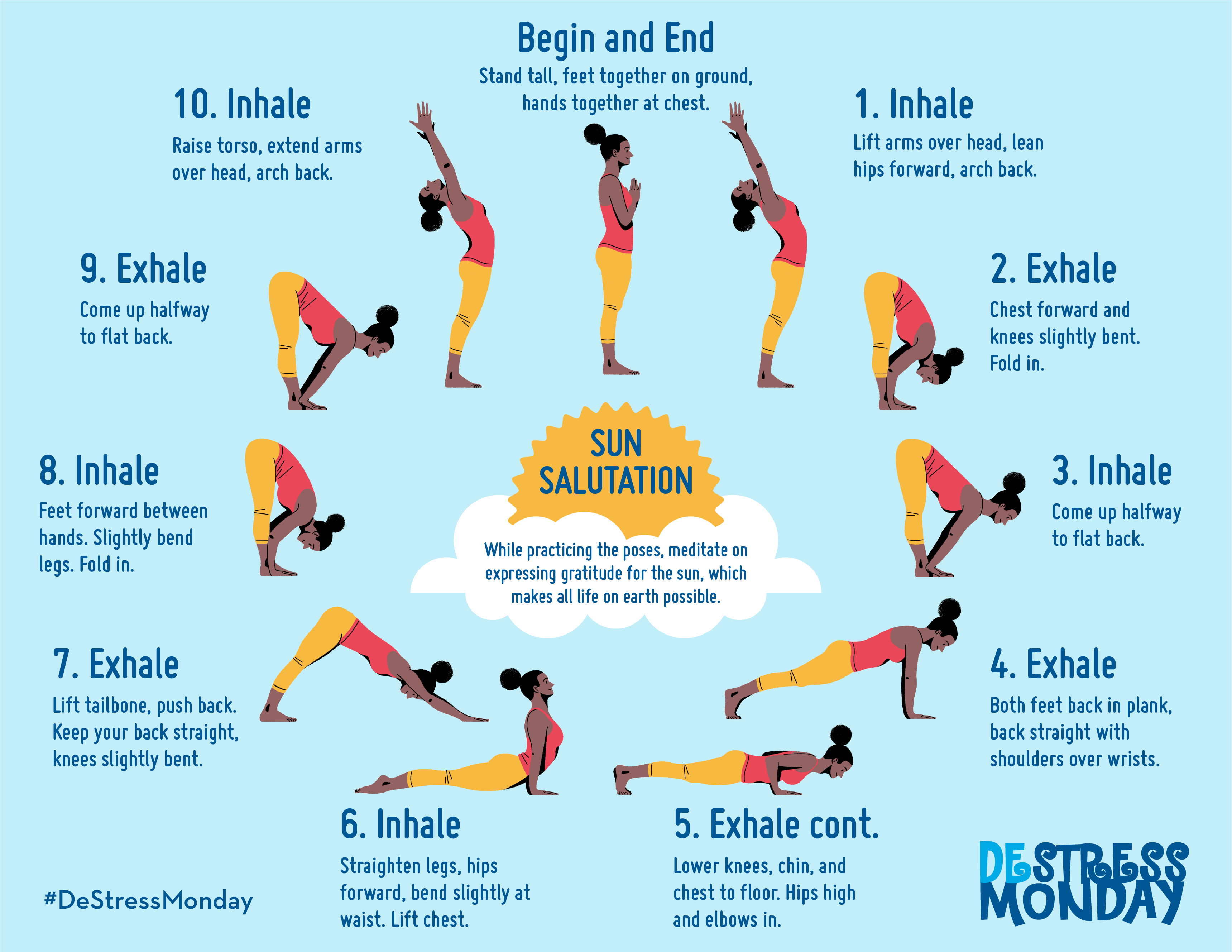
An All-Around Yoga Exercise: 12-Step Salute to the Sun

 One of the Yoga All-Around exercises is a 12-step tribute to the sun. Do it once or twice when you wake up in the morning to help reduce stiffness and refresh the body. Some repetitions at night will help you to relax; Insomnia often finds that six to 12 rounds help them fall asleep.


1. Stand with your feet a little separated, your palm together, thumb to your chest.


2. Take a deep breath -deeply while slowly raising your hand over your head, and bending back as far as possible, while tightening your buttocks. Hold for three seconds.


3. Slowly breath and bend forward, keep your knees straight, until your fingers touch the floor outside your feet. (If you can't touch the floor, go as close as possible.) Bring your head to your knees.


4. Inhale gently, bend your knees, and if your fingertips are not outside your feet on the floor, place it there. Slide your right foot back as far as you can, with a right knee about one inch from the floor, (Lunge position). Now look as high as possible, curve your back.


5. Before exhaling again, slide your left foot back to the right side, and with your weight supported on your palms and toes, straighten both legs so that your body forms a flat plane. Make sure your stomach is pulled.


6. Slowly breathing, bend your knees to the floor, bend with your hips in the air, lower your chest and forehead to the floor.


7. Now take a breathing slowly and look up, bow your head back, then remove, followed by your upper chest, then the lower chest. Your lower body - from the navel down - must be on the floor, and your elbows must be a little bent. Hold for three to five seconds.


8. Exhale slowly and lift your hips until the legs and palms are flat on the floor and arms and legs straight in the V position upside down.


9. Inhale gently and bring the right foot forward as in position 4. The foot must be flat on the floor between your fingertips. The left foot must be almost straight behind you, with a little knee from the floor. Lift your head, look up and curved your back.


10. Slowly breath and bring your left foot forward on your right. Straighten your feet and stand up, try to keep your fingertips on the floor, and try to touch your head to the knee like in position 3.


11. Take a breathing slowly, lift your arms up and fountain again as in position 2. Don't forget to tighten your buttocks. Hold for three seconds.


12. Slowly breathing, lower the arm to the side. Relax. Repeat the series.

Astanga Vinyasa Yoga

Astanga, or, sometimes, sperewly Ashtanga Yoga is really taught by a man named Sri K. Pattabhi Jois, in Mysore, India. He has brought Astang...